Publications RSS feed
- Correlated decoding of logical algorithms with transversal gates
Abstract
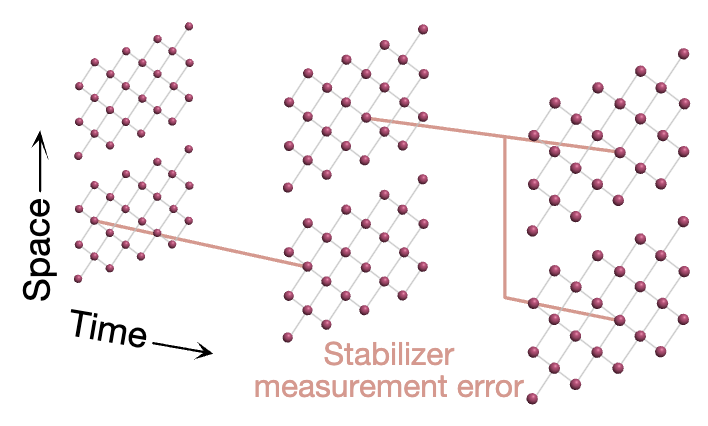
Quantum error correction is believed to be essential for scalable quantum computation, but its implementation is challenging due to its considerable space-time overhead. Motivated by recent experiments demonstrating efficient manipulation of logical qubits using transversal gates [Bluvstein et al., Nature (London) 626, 58 (2024)], we show that the performance of logical algorithms can be substantially improved by decoding the qubits jointly to account for error propagation during transversal entangling gates. We find that such correlated decoding improves the performance of both Clifford and non-Clifford transversal entangling gates, and explore two decoders offering different computational runtimes and accuracies. In particular, by leveraging the deterministic propagation of stabilizer measurement errors, we find that correlated decoding enables the number of noisy syndrome extraction rounds between gates to be reduced from O(d) to O(1) in transversal Clifford circuits, where 𝑑 is the code distance. We verify numerically that this approach substantially reduces the space-time cost of deep logical Clifford circuits. These results demonstrate that correlated decoding provides a major advantage in early fault-tolerant computation, as realized in recent experiments, and further indicate it has considerable potential to reduce the space-time cost in large-scale logical algorithms.
InPhysical Review Letters - Barren plateaus from learning scramblers with local cost functions
Abstract
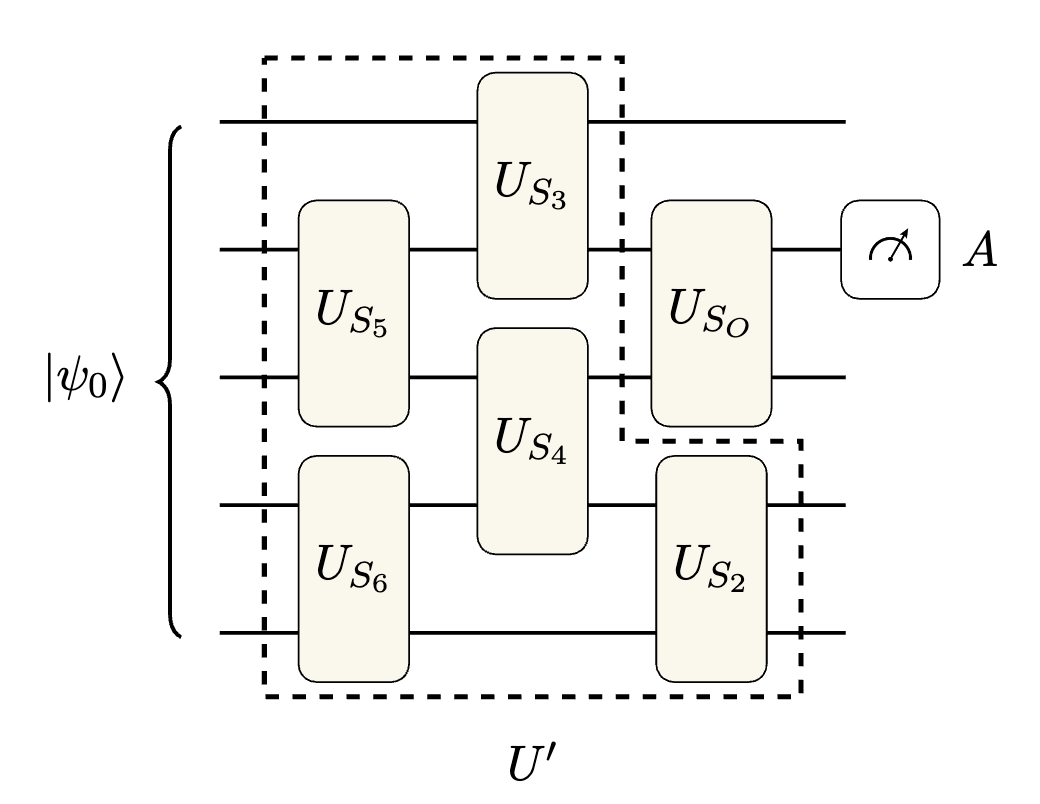
The existence of barren plateaus has recently revealed new training challenges in quantum machine learning (QML). Uncovering the mechanisms behind barren plateaus is essential in understanding the scope of problems that QML can efficiently tackle. Barren plateaus have recently been shown to exist when learning global properties of random unitaries, which is relevant when learning black hole dynamics. Establishing whether local cost functions can circumvent these barren plateaus is pertinent if we hope to apply QML to quantum many-body systems. We prove a no-go theorem showing that local cost functions encounter barren plateaus in learning random unitary properties.
InJournal of High Energy Physics - Analyzing the barren plateau phenomenon in training quantum neural networks with the ZX-calculus
Abstract
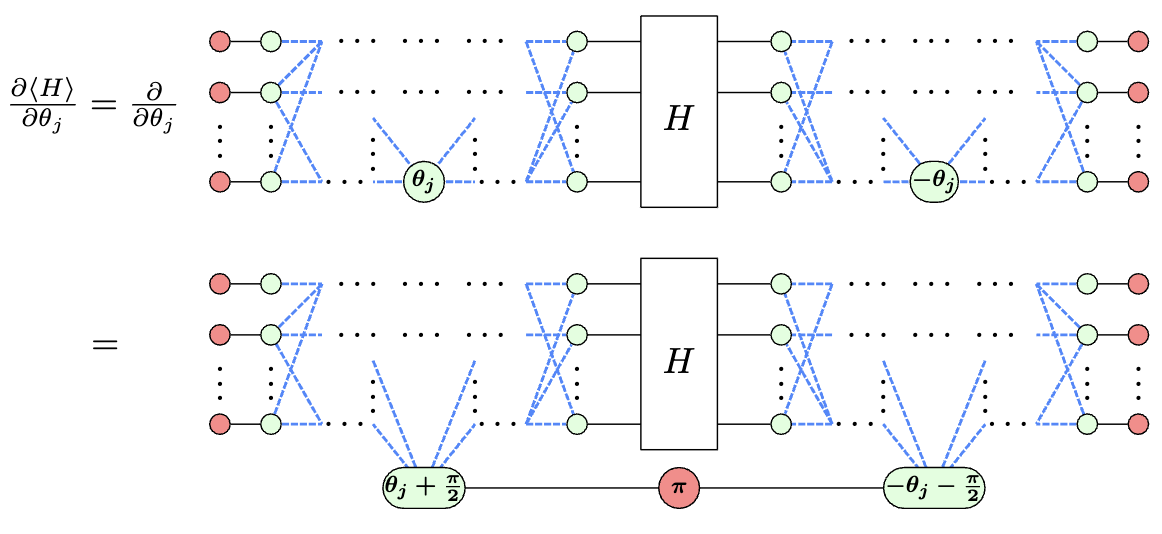
In this paper, we propose a general scheme to analyze the gradient vanishing phenomenon, also known as the barren plateau phenomenon, in training quantum neural networks with the ZX-calculus. More precisely, we extend the barren plateaus theorem from unitary 2-design circuits to any parameterized quantum circuits under certain reasonable assumptions. The main technical contribution of this paper is representing certain integrations as ZX-diagrams and computing them with the ZX-calculus. The method is used to analyze four concrete quantum neural networks with different structures. It is shown that, for the hardware efficient ansatz and the MPS-inspired ansatz, there exist barren plateaus, while for the QCNN ansatz and the tree tensor network ansatz, there exists no barren plateau.
InQuantum